Jishnu Vinayak Gopi

PhD Candidate · Computational Solid Mechanics · TU Bergakademie Freiberg
Chemnitzer Str. 6, 09599 Freiberg  ·  +49 178 287xxxx  ·  [email protected]

PhD candidate in computational solid mechanics with a background in computational materials science and mechanical engineering. My research focuses on thermo-mechanical finite element simulation of heterogeneous materials, combining mesostructure-resolved modeling, cohesive interface formulations, and Python-driven virtual laboratory workflows for simulation-based material evaluation. Prior to academia, I worked as a software developer for five years, giving me a practical grounding in structured software development alongside my research work.

Experience

Sep 2022 – Present
Research Assistant · PhD Candidate
Institute of Mechanics and Fluid Dynamics, TU Bergakademie Freiberg

PhD research within DFG Research Training Group GRK-2802. Focus: thermo-mechanical finite element simulation of heterogeneous MgO–C composites within a virtual laboratory framework connecting mesostructure generation, coupled thermal-structural FEM, and simulation-driven performance evaluation.

  • Developed a mesostructure generation tool using statistical phase distributions and Laguerre–Voronoi tessellation for automated FEM model generation of heterogeneous composite structures.
  • Formulated a coupled thermo-mechanical cohesive interface model capturing damage initiation and interfacial failure driven by thermal expansion mismatch.
  • Introduced a fracture-based parameter for numerical assessment of thermal shock resistance incorporating crack length and crack density.
  • Integrated mesostructure generation, constitutive modeling, and Python-based pre-/post-processing into a virtual laboratory framework for reproducible parametric studies.
Mar 2025 – Apr 2025
Exchange Research Scholar
Kevin T. Crofton Dept. of Aerospace & Ocean Engineering, Virginia Tech, USA

Research visit hosted by Prof. Gary D. Seidel on computational modeling of fracture and interface behavior in heterogeneous materials.

  • Comparative evaluation of interface modeling methods (CZM, Peridynamics, MPM) regarding accuracy, numerical cost, and implementation.
  • Presented research results and collaborated on multiphysics and multiscale modeling of advanced material systems.
Dec 2020 – Mar 2022
Student Research Assistant
Institute of Mechanics and Fluid Dynamics, TU Bergakademie Freiberg

Simulation-based and data-driven identification of material parameters from experimental small punch test data.

  • Developed automated Abaqus simulation workflows in Python for structured dataset generation used in machine learning–based parameter identification.
  • Trained a neural network (FFNET) for inverse identification of material hardening parameters, integrating physics-based simulation data with data-driven methods.
Oct 2014 – Sep 2019
Software Developer
Tata Consultancy Services

Development and maintenance of enterprise ERP web applications for industrial clients.

  • Developed web-based software components from requirements analysis to deployment.
  • Performed testing, validation, and system integration of new features.
  • Supported migration and modernization of legacy systems to improve performance and maintainability.

Education

Sep 2022 – Present
PhD – Computational Solid Mechanics
TU Bergakademie Freiberg, Germany

Thesis: "Modeling and Thermo-Mechanical Evaluation of Thermal Shock in MgO–C Refractories Using a Virtual Laboratory Framework"

Focus Areas
Thermo-mechanical FEM Fracture & Damage Mechanics Virtual Laboratory Development Coupled Thermal-Structural Analysis
Oct 2019 – May 2022
M.Sc. – Computational Materials Science
TU Bergakademie Freiberg, Germany
Grade: 1.5

Thesis: "Constitutive modeling of woven composites within an FE² multiscale simulation framework"

Relevant Coursework
Linear & Nonlinear FEM Fracture Mechanics Computational Plasticity Continuum Damage Mechanics Multiscale Modeling Micromechanics High Performance Computing
Jun 2010 – Jun 2014
B.Tech. – Mechanical Engineering
University of Kerala, India
Grade: 8.0 CGPA

Thesis: "Magnetostatic FEM Analysis of Magnetorheological Brakes using ANSYS APDL"

Relevant Coursework
Strength of Materials Thermodynamics Fluid Mechanics Machine Design Numerical Methods

Skills

Simulation & Modeling
Thermo-mechanical FEM (static & transient)4+ yrs
Finite Element Analysis5+ yrs
Fracture & Damage Mechanics5+ yrs
Mesoscale Modeling — Heterogeneous Materials4+ yrs
Virtual Laboratory / Digital Twin Workflows4+ yrs
Cohesive Zone Modeling4+ yrs
Multiscale Simulation2+ yrs
Programming & Scientific Computing
Python — automation, OOP, pipelines6+ yrs
Abaqus (Standard)5+ yrs
Fortran — UEL/UMAT5+ yrs
C++ — OOP, MPI2+ yrs
MATLAB2+ yrs
Java — ERP5+ yrs
Languages
Malayalam
Native
English
C1 · Professional
German
B1 · Intermediate

Publications

Gopi, J. V., Roth, S., Kiefer, B.
Geometric and constitutive modeling of MgO–C refractories based on recyclates for thermo-mechanical simulations
Proceedings in Applied Mathematics and Mechanics, 2024
Gopi, J. V., Roth, S., Aneziris, C. G., Kiefer, B.
Numerical exploration of thermal shock resistance in MgO–C refractories Published
Advanced Engineering Materials, 28(10), 2026
Gopi, J. V., Roth, S., Kiefer, B.
A novel thermo-mechanical cohesive zone model and its application to aggregate debonding in MgO–C refractories Published
International Journal of Solids and Structures, 339, 114182, 2026

Conferences

Sep 2025
International Conference on Fracture, Damage & Structural Health Monitoring
Rhodes, Greece
May 2024
19th European Mechanics of Materials Conference (EMMC19)
Madrid, Spain
Mar 2024
94th Annual Meeting of GAMM — Society of Applied Mathematics and Mechanics
Magdeburg, Germany

Projects

Sep 2022 – Present PhD · DFG GRK-2802
Virtual Laboratory Framework for MgO–C Refractory Composites
TU Bergakademie Freiberg · Institute of Mechanics and Fluid Dynamics

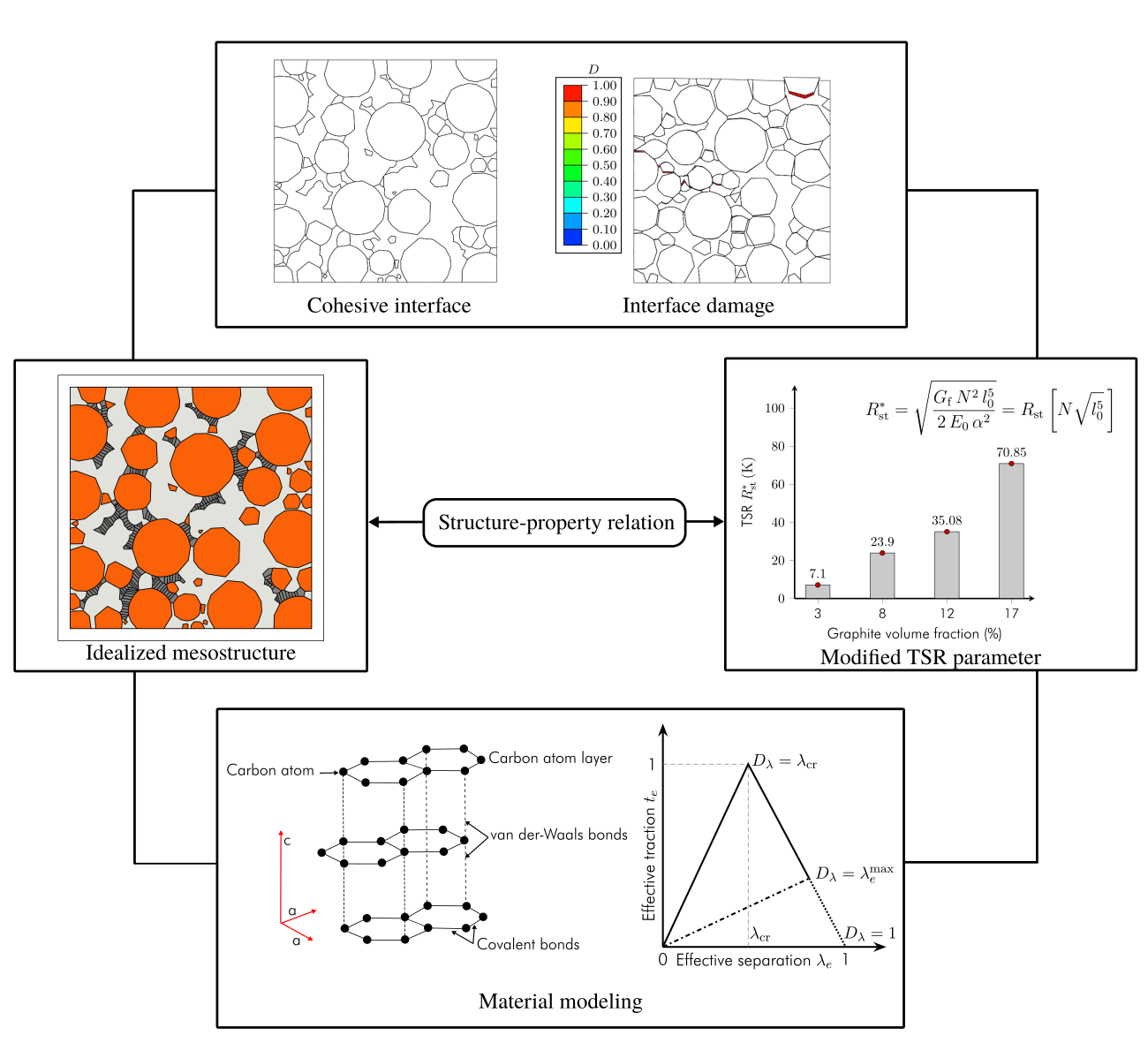
A fully integrated Python-driven virtual laboratory that connects statistical mesostructure generation, thermo-mechanical finite element analysis, and simulation-based performance evaluation for MgO–C refractory composites. The framework enables systematic parametric studies of thermal shock resistance without physical specimens, bridging the gap between mesostructure design and macroscopic material behaviour.

  • Laguerre–Voronoi tessellation-based mesostructure generator with statistical phase size distributions for realistic grain morphology.
  • Coupled transient thermal–structural FEM in Abaqus with temperature-dependent constitutive data for MgO and carbon phases.
  • Fracture-metric parameter for quantitative thermal shock resistance assessment from crack length and density fields.
  • Python automation layer for mesh generation, job submission, field output extraction, and result visualisation.
Abaqus Standard Python Thermo-mechanical FEM Laguerre–Voronoi Fracture Mechanics Virtual Laboratory Parametric Studies
PAMM 2024 · DOI: 10.1002/pamm.202400153
Adv. Eng. Mater., 28(10), 2026 · DOI: 10.1002/adem.202503153
Graphical abstract, GUI & architecture — click to view gallery (3 images)
2023 – 2025 PhD · Fortran / Abaqus
Coupled Thermo-Mechanical Cohesive Zone UEL
Custom Abaqus User Element for Aggregate Interface Debonding in Refractories

A Fortran-based Abaqus User Element (UEL) implementing a fully coupled thermo-mechanical cohesive zone model for simulating debonding at MgO aggregate–matrix interfaces driven by thermal expansion mismatch. The formulation accounts for temperature-dependent fracture properties and consistent tangent stiffness for quadratic convergence.

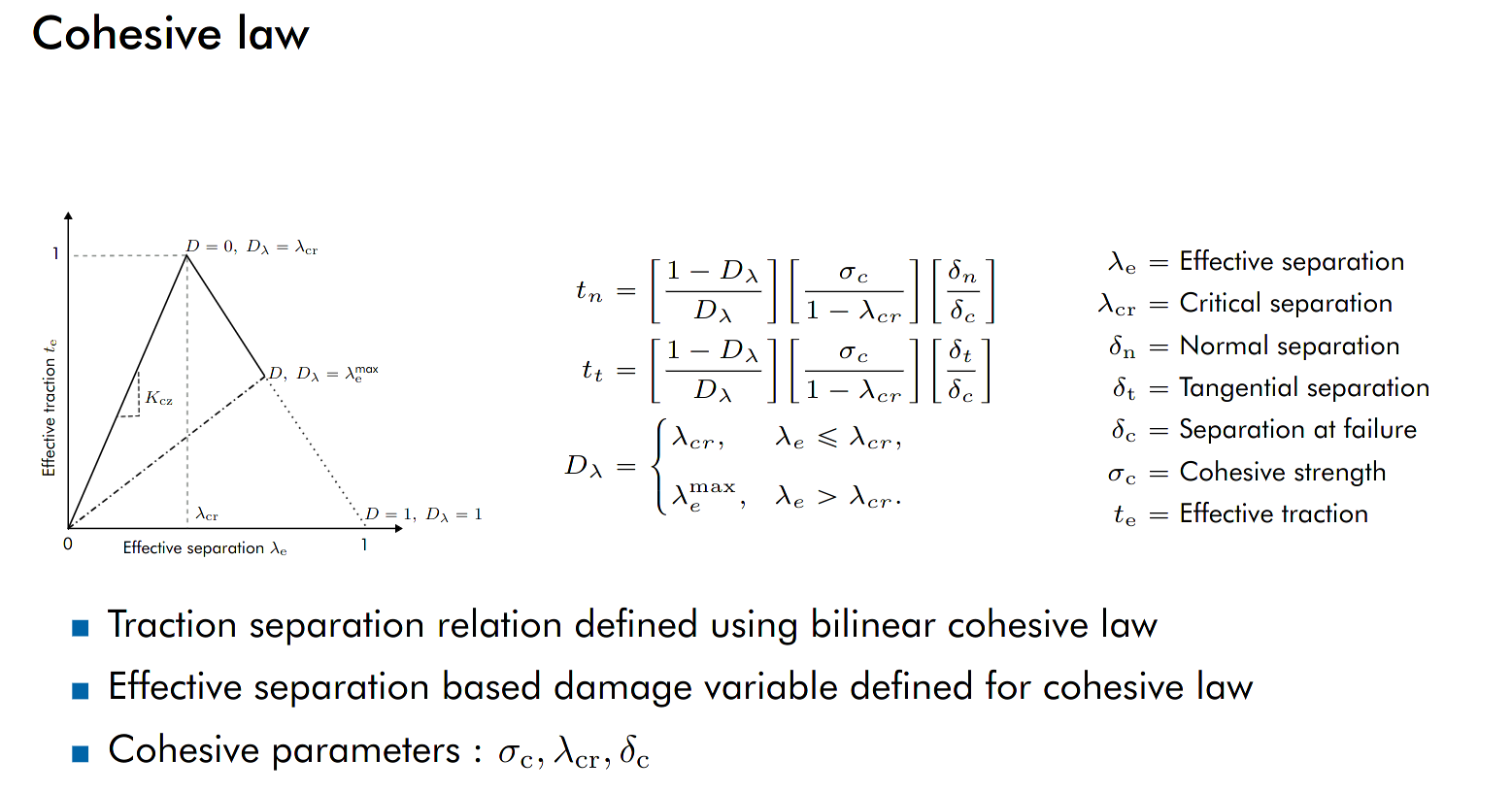
  • Thermodynamically consistent cohesive traction–separation law with thermal expansion mismatch as a damage driver.
  • Four-stage interface thermal conductance model governing heat transfer normal to the cohesive zone: intact interface (Kapitza thermal resistance), partial separation (Kapitza + gas + radiation), full separation (gas + radiation), and re-contact (gas + radiation + surface contact conductance).
  • Consistent algorithmic tangent for coupled thermal and mechanical degrees of freedom ensuring robust Newton–Raphson convergence.
  • Validated against analytical solutions and benchmark problems for interface debonding under thermal loading.
  • Integrated into the virtual laboratory mesh pipeline via Python-automated interface element insertion.
Fortran 90 Abaqus UEL Cohesive Zone Modeling Interface Mechanics Coupled Thermo-mechanics Consistent Tangent
IJSS, 339, 114182, 2026 · DOI: 10.1016/j.ijsolstr.2026.114182
Cohesive law, unloading, contact & heat transfer — click to view gallery (4 images)
Oct 2021 – May 2022 M.Sc. Thesis
FE² Multiscale Framework for Woven Composites
TU Bergakademie Freiberg · M.Sc. Thesis in Computational Materials Science (Grade: 1.5)

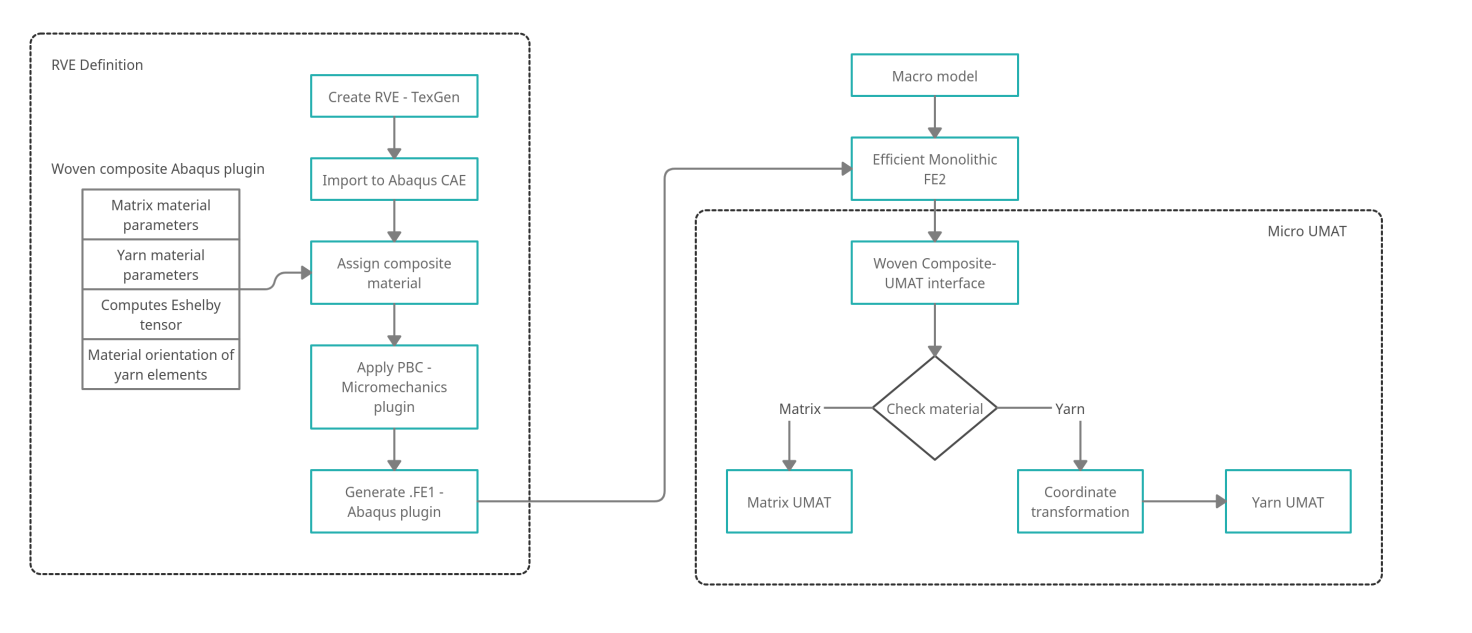
A two-scale finite element homogenisation framework (FE²) for woven fibre-reinforced composites, coupling macroscopic structural responses to microscale representative volume element (RVE) simulations. The implementation follows the Hill–Mandel macrohomogeneity condition and supports periodic, Dirichlet, and Neumann boundary conditions on the RVE.

  • Macroscale–microscale coupling via consistent tangent moduli derived from RVE condensation.
  • Python-driven woven RVE generator producing geometry and mesh for parametric weave architectures.
  • MPI-parallelised C++ solver for RVE computations, reducing wall-clock time for large parametric sweeps.
  • Validated effective elastic properties against analytical bounds (Voigt, Reuss, Hashin–Shtrikman).
FE² Homogenisation C++ / MPI Python Woven Composites RVE Modeling Multiscale FEM Hill–Mandel
Workflow, RVE results & UMAT algorithms — click to view gallery (5 images)
Dec 2020 – Mar 2022 M.Sc. · Research Assistantship
Neural Network–Based Inverse Material Parameter Identification
TU Bergakademie Freiberg · Small Punch Test · Data-Driven Mechanics

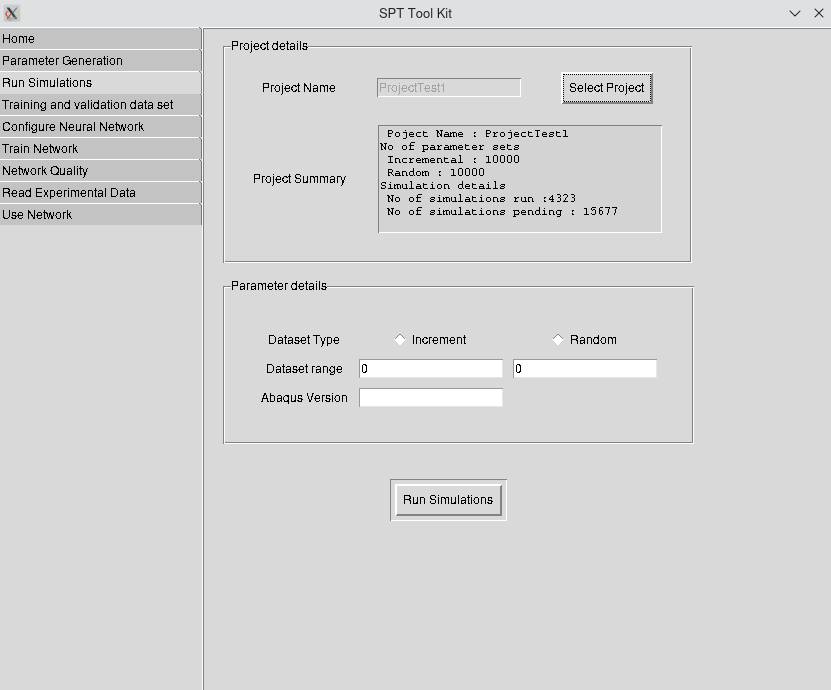
A physics-informed data-driven pipeline for identifying nonlinear material hardening parameters from small punch test (SPT) force–displacement data. Abaqus FEM simulations were used to build a structured training dataset, and a feedforward neural network (FFNET) was trained to perform the inverse mapping from punch curve features to constitutive parameters.

  • Automated Abaqus Python scripting for systematic generation of labelled simulation datasets across parameter space.
  • Feature extraction from force–displacement curves (energy, slope, characteristic points) as neural network inputs.
  • Feedforward network trained on simulation data; validated against held-out FEM cases and experimental SPT results.
  • Demonstrated significant reduction in identification time compared to iterative optimisation approaches.
Python Neural Networks (FFNET) Abaqus Scripting Inverse Methods Small Punch Test Data-driven Mechanics Parameter Identification
SPT Tool Kit — data generation to prediction — click to view gallery (5 images)
WS 2020/21 HPC Course · C++ / MPI
Parallel Image Convolution with MPI
TU Bergakademie Freiberg · Programming Project in High Performance Computing

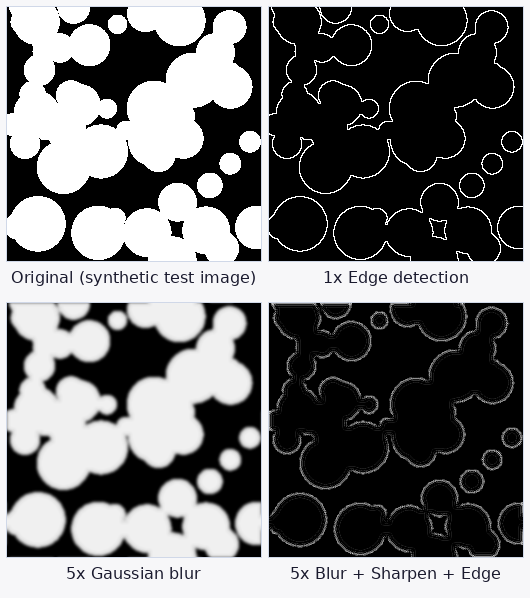
A parallel image processing program implementing Gaussian blur, sharpening, and Laplacian edge detection on large grayscale PGM images using C++ and MPI. The design decomposes the image into row-wise batches distributed across ranks, exchanges halo rows via non-blocking point-to-point communication with periodic rank topology, and collects results with MPI_Gather for PGM file output. Benchmarked on the TU Freiberg cluster up to 36 processes across three nodes.

  • Distributed file I/O: each rank independently opens the PGM file, skips rows outside its assigned batch using a pixel-read loop, and stores only its own batchSize × numberCol slice — avoiding any broadcast of the full image.
  • Non-blocking halo exchange: MPI_Isend / MPI_Irecv with periodic rank topology (rank 0 ↔ rank size−1) for correct boundary treatment at the top and bottom of the domain; followed by MPI_Barrier before convolution.
  • Three convolution kernels: Gaussian blur (3×3, weights stored as floats, 1/16 normalisation), sharpen, and Laplacian edge detection — all with periodic column-wise boundary handling and [0, 255] pixel clamping.
  • Chained pipeline for Task 3: performConvolution() is parameterised by flag (B/S/E) and iteration count; Task 3 chains 5× blur → 1× sharpen → 1× edge detection through intermediate PGM files, each stage collecting via MPI_Gather on rank 0.
  • Strong scalability: wall-time for the full Task 3 pipeline (5× blur → sharpen → edge detection) on an 8162×8162 image reduced from 133.6 s (1 process) to 39.9 s (36 processes), a ~3.3× speedup; gains taper beyond 12 processes as communication and I/O overhead dominate.
C++ MPI MPI_Isend / MPI_Irecv MPI_Gather Domain Decomposition Halo Exchange Strong Scalability PBS / HPC Cluster
Convolution results, scalability & decomposition — click to view gallery (3 images)
WS 2020/21 Personal Programming Project · Fortran / Abaqus UEL
Locking-Free User Elements for Finite Strain Metal Plasticity
TU Bergakademie Freiberg · Personal Programming Project — Guidance: Dr.-Ing. habil. Geralf Hütter

Implementation of two volumetric-locking-free element formulations — Generalized Selective Reduced Integration (GSRI) and the hybrid u/p formulation — as Abaqus User Elements (UEL) in Fortran 90, in the context of finite-deformation metal plasticity. Six element types were delivered, spanning 2D axisymmetric and 3D hexahedral geometries with both linear and Johnson–Cook nonlinear isotropic hardening. The implementation extends an in-house library and is validated through a 31-case test suite with automated Python post-processing and PDF test reporting.

  • GSRI formulation: modified strain–displacement matrix via dilatational/deviatoric decomposition (B̄ = Bdev + B̄dial); dilatational components integrated at a single central Gauss point while deviatoric components are fully integrated — directly preventing volumetric locking without added DOFs.
  • Hybrid u/p formulation: separate pressure/displacement interpolation with element-level pressure DOF; assembled coupled stiffness system Kuu, Kup, Kpu, Kpp using Updated Lagrangian linearization; implemented for both 2D axisymmetric (4/1 element) and 3D hexahedral cases.
  • Material model: hypoelastic-plastic model with Jaumann objective stress rate, von Mises yield criterion, and general radial return algorithm; local Newton–Raphson scheme for the plastic multiplier under Johnson–Cook nonlinear hardening; midpoint configuration used for objective time integration of the stress rate.
  • Six UEL definitions (U3001–U3006): 2D AX and 3D hexahedral elements for GSRI (linear/nonlinear hardening) and hybrid (linear hardening), all selectable via Abaqus input file keyword — no code changes required to switch formulation.
  • Validation (31 test cases): unit tests per module, rigid body motion and constant strain patch tests (2D + 3D, both methods), single-element tests under tension and shear with frame-indifference check, and a benchmark necking-of-circular-bar test against published reference data. GSRI elements pass all tests; hybrid 2D convergence beyond yield identified as a known 4/1 element order limitation.
  • Python post-processing pipeline: Abaqus odbAccess for field output extraction, subprocess calls to bypass Abaqus Python library restrictions, and PyFPDF for automated generation of structured test-report PDFs per test case.
Fortran 90 Abaqus UEL GSRI Hybrid u/p Updated Lagrangian Radial Return Johnson–Cook Python / PyFPDF Finite Strain Plasticity